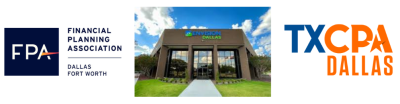
Join FPA DFW and TXCPA for a Behind-the-Scenes Experience at Envision Dallas!
Registration will close at 5:00pm, February 11.
Get an exclusive look inside Envision Dallas’ new facility during this special behind-the-scenes event. Attendees will enjoy lunch, a one-hour CPE presentation and a guided tour of Envision’s facility, gaining a firsthand understanding of their mission-driven work that supports individuals who are blind or visually impaired.
This event will not qualify for CE credit.
Transparency and Trust: Financial Reporting That Inspires Donors and Regulators
Mark Eaton, CFO
Description: Focuses on nonprofit reporting best practices, the evolving audit environment, and how CFOs communicate financial integrity to multiple audiences (board, funders, and the public).
Major Topics:
- Nonprofit Financial Reporting Essentials: Key statements, required disclosures, donor-restricted vs. unrestricted funds, functional allocation, and program ratios.
- Governance & Internal Controls: Standards for financial integrity, internal control design, and ethical considerations.
- Audit & Regulatory Landscape: Recent audit requirement changes, common nonprofit audit findings, and preparing staff for successful audits.
- Stakeholder Communication: What boards and funders expect; translating financial data into clear, compelling narratives.
- Public Disclosure & Compliance: Form 990 expectations, online transparency, charity ratings, and managing public trust.
- Strengthening Donor Confidence: Stewardship of contributions, restricted fund management, linking impact to financial results.
- Case Examples: Effective transparency practices, audit pitfalls, and how financial clarity enhances credibility and fundraising.
Objectives: By the end of this session, participants will be able to: Identify key nonprofit financial reporting standards and best practices that enhance accuracy, clarity, and compliance. Evaluate how evolving audit requirements and regulatory expectations affect nonprofit accounting and operational workflows. Apply strategies for communicating financial integrity and organizational impact to diverse stakeholders, including boards, donors, grantmakers, and the public. Analyze common transparency pitfalls in nonprofit reporting and develop approaches to strengthen internal controls and financial governance. Design dashboards, reports, and narratives that build donor confidence, support fundraising efforts, and withstand regulatory scrutiny. Understand the role of CFOs and finance leaders in shaping trust, accountability, and long-term sustainability within mission-driven organizations.
Building Scalable Accounting Systems in a Multi-Entity Nonprofit
Troy McKissick, Vice President and Controller
Description: Covers how Envision manages financial reporting and consolidation across multiple business units—including a 161-person workforce where nearly 80% are blind or visually impaired.
Major Topics:
- Multi-Entity Structures: Types of nonprofit units, governance considerations, and Envision’s organizational challenges.
- Scalable Systems & Technology: Chart of accounts design, entity tagging, consolidation modules, automation, and accessible systems for BVI staff.
- Consolidation & Close Processes: Intercompany billing, eliminations, standardized workflows, and ensuring accuracy and audit readiness.
- Internal Controls: Role-based access, segregation of duties, and accessibility adaptations.
- Inclusive Process Design: Workflow accessibility, training, and communication for a predominantly BVI workforce.
- Financial Reporting for Decision-Making: Dashboards, KPIs, and unit-level scorecards for leadership insight.
- Case Study: Envision’s real-world approach to scalable accounting during growth.
Objectives: By the end of this session, participants will be able to: Understand the structural and operational complexities of a multi-entity nonprofit and how they impact accounting workflows, reporting, and compliance. Identify key components of scalable financial systems that support consolidation, intercompany activity, and multi-unit reporting. Evaluate how to design internal controls and processes suitable for a large, diverse workforce—including accommodations that ensure accessibility for staff who are blind or visually impaired (BVI). Analyze strategies for timely, accurate month-end close and consolidated reporting across multiple business units or cost centers. Apply best practices for selecting and integrating accounting technologies, automation tools, and workflow systems to support organizational growth. Communicate financial results effectively to leadership, program teams, auditors, and external stakeholders in a multi-entity environment.
Aligning Finance and Operations: FP&A Inside a Mission-Driven Manufacturer
Doug Altimari, Director, Finance-Manufacturing Management
Description: Explains how finance partners with production teams to manage cost of goods sold, track KPIs, and improve operational decision-making.
Major Topics:
- FP&A in Nonprofit Manufacturing: Dual bottom line (mission + financial performance) and how operations differ from for-profit models.
- Operational Drivers: Labor, capacity, materials, inventory, vendor management, and contribution margin analysis.
- Forecasting & Budgeting: Sales and production forecasting, modeling COGS and labor, scenario planning.
- Cross-Functional Collaboration: Integrating daily/weekly production data into financial models and improving accuracy through feedback loops.
- KPIs & Dashboards: Throughput, yield, labor efficiency, scrap, and mission-aligned KPIs such as BVI workforce participation.
- Workforce Considerations: Accessibility, training needs, and evaluating the return on workforce development efforts.
- Strategic Planning: Multi-year forecasts, equipment investment, and the role of manufacturing revenue in long-term stability.
- Case Study: Lessons learned in aligning finance and operations for improved impact.
Objectives: By the end of this session, participants will be able to: Understand how FP&A functions within a nonprofit manufacturing environment and how it differs from traditional for-profit manufacturing models. Analyze the relationship between operational drivers (labor, materials, production flow, capacity) and financial outcomes. Evaluate tools and methods for forecasting revenue, cost of goods sold, labor productivity, and program impact in a mission-driven setting. Apply FP&A techniques that support strategic planning, resource allocation, and operational decision-making. Develop dashboards, KPIs, and reporting frameworks that communicate performance to leadership, funders, and program teams. Assess how alignment between finance and operations can strengthen mission delivery, workforce development, and long-term sustainability.
Space is limited!
Reserve your spot today by clicking REGISTER above!